
Business
US Government Advises Citizens Against All Travel to Russia: Latest 2026 Travel Warning Explained


The US government advises citizens against all travel to Russia, and that warning remains firmly in place in 2026. As of August 8, 2026, the U.S. Department of State continues to classify the Russian Federation as a Level 4: Do Not Travel destination, the highest level in its travel advisory system. The latest Russia-specific advisory is dated December 29, 2025, and tells Americans not to travel to the country for any reason. U.S. citizens who are already in Russia are advised to leave. The government points to the continuing war between Russia and Ukraine, the possibility of wrongful detention, terrorism, unrest, enforcement of local laws, and serious limits on the assistance U.S. officials may be able to provide.
For Americans considering a holiday, business trip, family visit, study program, or another reason for entering Russia, the warning deserves more attention than an ordinary travel notice. Level 4 is not simply a suggestion to be more careful while sightseeing. It reflects the State Department’s assessment that Americans could face significant risks and that the U.S. government’s ability to respond to an emergency may be restricted.
Understanding what the advisory actually says—and why it remains in effect—is therefore essential before making any decision involving travel to Russia.
Why the US Government Advises Citizens Against All Travel to Russia
The current warning is based on several risks that overlap with one another.
According to the State Department, Russia’s Level 4 advisory includes risk indicators for terrorism, unrest, wrongful detention, and other threats. The official guidance also specifically identifies dangers associated with the continuing Russia-Ukraine war and the possibility of arbitrary enforcement of Russian laws.
That distinction matters.
A traveler may think primarily about military activity when hearing warnings connected with Russia. Yet the U.S. advisory is considerably broader. An American could encounter problems without going anywhere near an active conflict area.
Questions involving local law enforcement, political activity, digital communications, dual citizenship, financial access, transportation, and diplomatic assistance all form part of the wider risk picture.
The State Department’s message is therefore national rather than limited to one border area or one type of traveler.
US Government Advises Citizens Against All Travel to Russia Under Level 4 Guidance
The State Department uses four main levels when assessing overseas destinations.
Level 1 means travelers should exercise normal precautions.
Level 2 means travelers should exercise increased caution.
Level 3 recommends reconsidering travel.
Level 4 means do not travel.
Russia remains in the fourth and highest category. The State Department’s current advisory page lists the country at Level 4 and states that Americans should not travel there for any reason.
It is useful, however, to understand what a travel advisory is and what it is not.
A Level 4 advisory is an official risk assessment and recommendation from the U.S. government. By itself, it is not the same thing as a blanket law making every visit by a private American citizen illegal. Travelers can nevertheless be affected by separate visa rules, sanctions, export controls, financial restrictions, and Russian laws.
The practical message remains unmistakable: the U.S. government believes the risks are serious enough that Americans should avoid the trip.
The Russia-Ukraine War Remains a Central Security Concern
Russia’s war against Ukraine continues to influence security conditions inside Russia as well as throughout the wider region.
Travelers sometimes assume that being far from the front line removes conflict-related risk. That is not necessarily the case.
Modern warfare can affect airspace, airports, transportation infrastructure, border regions, communications, and security procedures far beyond areas where ground fighting occurs. Conditions can also change quickly following military or political developments.
The State Department cites the continuing war as one of the reasons Americans should not travel to Russia.
For a private traveler, the concern is not only the possibility of encountering a conflict-related incident. The wider consequence is unpredictability.
Transportation can become harder to arrange. Authorities may impose new restrictions. Security measures may intensify. Areas considered relatively stable at one moment can face disruption later.
In a destination already subject to reduced U.S. diplomatic capacity, sudden changes create additional complications.
Wrongful Detention Is One of the Most Serious Risks for Americans
The risk of detention receives particular attention in the U.S. advisory.
The State Department warns about harassment and wrongful detention of U.S. citizens by Russian security officials. The advisory also says Americans have been questioned, threatened, and detained.
This is different from the normal risk that any traveler could face consequences after clearly violating a foreign law.
Wrongful detention concerns involve circumstances in which the U.S. government believes an American may be detained improperly or used for purposes beyond ordinary law enforcement.
For travelers, the important point is that American citizenship does not place someone outside Russian jurisdiction.
Once inside another country, visitors are generally subject to that country’s laws and judicial procedures. U.S. consular officials may seek to assist an American who is detained, but their powers have clear limits.
The State Department explains that consular officials can provide information about local attorneys, communicate with family in appropriate circumstances, and seek access to detained U.S. citizens. They cannot simply remove a person from detention, provide legal representation, declare someone innocent in court, or pay legal expenses.
That limitation becomes particularly significant in Russia because diplomatic access itself may be restricted.
Reduced U.S. Diplomatic Capacity Makes Emergencies More Difficult
One of the less obvious parts of the Russia travel warning concerns consular support.
Many international travelers assume that an American embassy will always be able to intervene quickly if they lose documents, are detained, become stranded, or face another emergency.
Russia presents a more difficult environment.
The State Department says the U.S. government’s ability to help citizens in Russia is limited, especially outside Moscow. The U.S. Embassy in Moscow has reduced staffing, while the Russian government has also restricted travel by embassy personnel.
Geography makes this even more relevant.
Russia is the world’s largest country by land area. Someone experiencing a serious problem far from Moscow could be separated from the embassy by enormous distances.
For Americans who choose to enter Russia despite the warning, depending on the U.S. government as an emergency evacuation plan would therefore be risky.
The State Department specifically recommends having plans that do not rely on U.S. government assistance.
Local Laws Can Create Unexpected Problems
Travelers sometimes prepare extensively for transportation, hotels, and sightseeing while spending very little time studying local law.
That can be a major mistake in a high-risk destination.
The U.S. government highlights arbitrary enforcement of local laws as one of its concerns about Russia.
An action that appears harmless to an American visitor may be viewed very differently by Russian authorities.
Political expression is an especially sensitive area. Participation in demonstrations, public criticism, activism, or online discussion of politically sensitive subjects can attract attention from authorities.
The State Department notes that Americans have been arrested after joining protests and that both Russian nationals and U.S. citizens have faced detention connected with social-media posts.
Travelers should never assume that rights associated with speech or protest under the U.S. Constitution apply in exactly the same way when they are physically present in another country.
Electronic Devices and Social Media Add Another Layer of Risk
Phones and laptops have become such normal parts of daily life that many travelers barely consider them a security issue.
The State Department’s Russia guidance specifically tells Americans to reconsider bringing electronic devices into the country.
It advises U.S. citizens to assume that electronic communications and devices in Russia may be monitored by Russian security services. The department also says foreign nationals have been arrested based on information found on electronic devices, including information that originated outside Russia.
That means a traveler’s digital history can matter even when the content was not created during the trip.
Photos, messages, social-media activity, saved documents, political comments, professional information, and other stored material could potentially create complications depending on the circumstances.
The current advisory goes as far as recommending that travelers log out of social-media accounts and avoid accessing those accounts while in Russia.
For journalists, researchers, government workers, activists, business executives, and people connected with politically sensitive organizations, the digital-security dimension may be particularly important.
Dual U.S.-Russian Citizens Face Special Concerns
Dual nationality can create complications that ordinary tourists may not encounter.
A person who holds both American and Russian citizenship may expect U.S. citizenship to guarantee access to American consular protection. In practice, the situation can be more complicated when that person is inside Russia.
Foreign governments are generally entitled to apply their own nationality laws. Russia may therefore treat a dual U.S.-Russian citizen as Russian while that person is within Russian territory.
The State Department specifically tells travelers to consider the risks associated with dual U.S.-Russian nationality.
This can affect questions surrounding entry and exit procedures, passports, military obligations, detention, and consular access.
Anyone who possesses Russian citizenship—or believes Russian authorities could regard them as a citizen—should therefore research their legal position carefully rather than assuming possession of a U.S. passport settles the issue.
Terrorism Remains an Official Risk Indicator
Terrorism is another reason Russia remains under a Level 4 advisory.
The possibility of an attack cannot be predicted with certainty for an individual traveler. Nevertheless, terrorism risk is specifically included in the State Department’s current assessment.
Public areas can become especially important in such warnings because attacks may target places where large numbers of people gather.
Travel hubs, entertainment districts, events, hotels, restaurants, shopping areas, and places of worship can all become vulnerable environments during periods of elevated security concern.
For visitors unfamiliar with local emergency procedures or the Russian language, responding to a fast-developing incident can be especially challenging.
This is one reason official travel assessments look beyond ordinary crime statistics when deciding how a destination should be classified.
Payment and Banking Problems Can Affect American Travelers
Even if a visitor encounters no direct security problem, everyday financial transactions can be difficult.
The State Department says U.S. credit and debit cards no longer work in Russia and warns that electronically transferring money from the United States to Russia can be extremely difficult.
The wider financial environment is shaped by extensive sanctions imposed in connection with Russia.
U.S. Treasury guidance shows that sanctions remain broad and continue to affect numerous Russian financial institutions. At the same time, Treasury notes that legitimate personal, non-commercial remittances are not generally the intended target of U.S. sanctions when they do not involve blocked persons or otherwise prohibited transactions.
For an ordinary traveler, however, the legal detail does not change the practical problem: familiar payment systems may not function as expected.
Imagine arriving in another country and discovering that the bank card normally used for hotels, meals, transportation, or emergencies cannot be used.
In a destination with limited consular support and restricted travel options, loss of access to funds can quickly become more than a minor inconvenience.
Air Travel and Departure Options Are Limited
Leaving Russia may also be more complicated than travelers expect.
The State Department says commercial air options are limited and warns that booking a flight on short notice may be difficult. Americans who want to leave are told to make their own travel arrangements.
Direct aviation links between Russia and the United States have also been significantly affected.
The Federal Aviation Administration downgraded Russia’s international aviation safety assessment to Category 2 in April 2022 after determining that Russia’s civil aviation authority did not meet applicable International Civil Aviation Organization safety standards under the FAA’s assessment program. At the time of that announcement, no airlines were operating regularly scheduled service between Russia and the United States.
For many travelers, reaching the United States therefore involves connections through third countries.
That adds another layer of uncertainty because travelers must consider transit rules, available routes, ticket availability, and changing airline schedules.
What Should U.S. Citizens Already in Russia Do?
The State Department’s current recommendation is not limited to people who are considering a future trip.
It says U.S. citizens who are already in Russia should leave immediately.
Americans remaining in the country are encouraged to keep travel documents current and accessible, monitor local developments, stay aware of their surroundings, and maintain independent plans for emergencies.
Another useful tool is the Smart Traveler Enrollment Program, commonly known as STEP.
STEP is a free State Department service through which Americans traveling or living abroad can receive updates and alerts from the relevant U.S. embassy or consulate. It can also help diplomatic officials contact a traveler—or an emergency contact—during a crisis.
STEP alerts can include information about security incidents, demonstrations, health issues, natural disasters, changes to travel advisories, and embassy services.
Enrollment does not eliminate risk, nor does it guarantee evacuation or immediate consular assistance. It simply improves access to official information and communication.
Does the Russia Warning Apply Only to Tourists?
No.
The wording of the advisory is broad: Americans are told not to travel to Russia for any reason.
That includes far more than conventional tourism.
The warning is relevant to people considering business travel, academic programs, journalism, research, cultural events, family visits, religious activities, long-term stays, and other forms of travel.
A personal reason for visiting may be important, urgent, or emotionally significant, but it does not automatically reduce the underlying security risks.
Someone considering travel because of an unavoidable family, legal, or professional situation should pay particular attention to current official guidance and appropriate professional advice.
Why the Date of the Advisory Matters
Travel information becomes outdated quickly, particularly when geopolitical conditions are unstable.
The current Russia-specific advisory was issued on December 29, 2025. The State Department notes that the advisory level and risk indicators did not change during that update; rather, the advisory summary was revised. Russia remained at Level 4.
As of August 8, 2026, the State Department’s active travel-advisory list still shows Russia as Level 4: Do Not Travel.
That distinction is useful for readers who encounter headlines claiming that the United States has “just” banned or newly warned against travel to Russia.
The Level 4 status is not a brand-new development in August 2026. What matters is that the warning remains active.
Readers should always check the date of both the news report and the underlying government advisory before assuming that an old warning represents a new policy change.
Is Travel to Russia Banned for U.S. Citizens?
This is one of the most common sources of confusion.
A State Department Level 4 advisory is not, on its own, identical to a legal prohibition on entering the country.
The government is strongly recommending that Americans do not go, rather than announcing through the travel advisory that every private trip is automatically unlawful.
However, that does not mean travel is straightforward.
Visa requirements, Russian immigration rules, U.S. sanctions, financial restrictions, export-control rules, and other legal obligations can apply depending on what a traveler plans to do.
Russian authorities also strictly enforce visa and immigration requirements, according to State Department destination information. Violations can lead to administrative penalties, deportation, or future entry restrictions.
Travelers should therefore avoid interpreting “not technically a blanket ban” as “safe” or “simple.”
Those are very different questions.
The Wider Meaning of the U.S. Warning
Russia’s Level 4 status demonstrates how modern travel risk goes far beyond conventional concerns such as theft, traffic accidents, or illness.
An American considering Russia in 2026 has to think about geopolitical conflict, diplomatic relations, detention risk, local law, digital privacy, banking access, international sanctions, transportation, dual nationality, terrorism, and the availability of consular services.
Each issue adds another layer.
Together, they explain why the State Department’s recommendation remains so strong.
This broader context is also important for organizations. Universities, businesses, media companies, humanitarian groups, and other institutions often consider government travel advisories when deciding whether employees, students, or contractors should travel.
Insurance policies may also contain conditions involving destinations under official government warnings, which makes it important to read actual policy terms before relying on coverage.
Semantic Context: What Travelers Should Understand Beyond the Headline
When discussing why the US government advises citizens against all travel to Russia, several related subjects help explain the full picture.
These include the U.S. Department of State travel advisory, Russia Level 4 warning, Do Not Travel designation, Russia-Ukraine war, wrongful detention of Americans, U.S. Embassy Moscow, consular assistance, Russian local laws, terrorism risk, civil unrest, dual U.S.-Russian nationality, Russian visa requirements, U.S. sanctions on Russia, international banking restrictions, credit card limitations, commercial flight availability, electronic-device monitoring, social-media risks, emergency evacuation planning, and the Smart Traveler Enrollment Program.
Together, these topics provide a more accurate picture than the headline alone.
The advisory is not based on a single threat, and it should not be interpreted as though every part of Russia carries exactly the same type of danger at every moment. Instead, the Level 4 designation represents the U.S. government’s overall assessment of the risks that American citizens may encounter.
What Travelers Should Check Before Relying on Any Russia Travel News
Anyone researching Russia travel should pay attention to the source of the information.
Social-media posts, travel videos, online forums, and personal experiences can be useful for understanding what individual travelers encountered, but they cannot replace official government guidance.
Someone who visited Moscow without problems several months ago cannot guarantee that another traveler will have the same experience.
Likewise, a viral headline may oversimplify an advisory or make an old government notice appear new.
For the most reliable picture, Americans should check the current Russia page on the U.S. State Department’s travel website, review embassy notices, examine entry and exit requirements, and consider relevant Treasury sanctions guidance when financial transactions are involved.
The State Department also recommends checking travel advisories before an international trip and enrolling in STEP for destination-specific alerts.
Conclusion
The fact that the US government advises citizens against all travel to Russia remains highly relevant in 2026.
As of August 8, 2026, Russia is still classified by the U.S. Department of State as a Level 4: Do Not Travel destination. The latest Russia advisory is dated December 29, 2025 and identifies multiple concerns, including the continuing war with Ukraine, terrorism, unrest, wrongful detention, arbitrary enforcement of local laws, and limited U.S. government capacity to help Americans inside the country.
The warning also needs to be viewed alongside practical problems involving electronic devices, banking, U.S.-issued payment cards, air travel, dual nationality, and reduced consular support.
For Americans already in Russia, official guidance advises leaving. For those planning a visit, the State Department’s position is even simpler: do not travel there for any reason.
Most importantly, travelers should distinguish between availability and safety. A visa may be obtainable. A hotel may accept a reservation. A flight route may exist through another country. None of those facts means the U.S. government’s assessment has changed.
Until an official State Department update lowers the advisory level, Russia should continue to be treated as a high-risk destination for U.S. citizens.
Frequently Asked Questions
1. Why is Russia under a Level 4 U.S. travel advisory?
Russia is under a Level 4 “Do Not Travel” advisory because the State Department identifies several serious risks. These include dangers associated with the Russia-Ukraine war, terrorism, unrest, wrongful detention, arbitrary enforcement of Russian laws, and limited U.S. government ability to assist citizens inside Russia.
2. What is the latest U.S. travel advisory for Russia in 2026?
As of August 8, 2026, Russia remains at Level 4: Do Not Travel. The latest Russia-specific advisory listed by the State Department is dated December 29, 2025. That update did not change the advisory level or its main risk indicators; it updated the advisory summary.
3. Can a U.S. citizen still legally travel to Russia?
The Level 4 State Department advisory is a strong recommendation against travel rather than, by itself, a blanket legal ban on every private American entering Russia. Travelers must still comply with applicable Russian visa rules, immigration laws, U.S. sanctions, export controls, and other regulations. The U.S. government’s current recommendation remains not to travel.
4. What should Americans currently in Russia do?
The State Department advises U.S. citizens currently in Russia to leave. It also recommends maintaining independent emergency plans, keeping travel documents accessible, monitoring developments, and enrolling in STEP to receive embassy alerts and security information.
5. Why are dual U.S.-Russian citizens a special concern?
Dual nationals may face additional complications because Russian authorities can treat them as Russian citizens while they are inside Russia. This can affect consular access and other legal matters. The current U.S. advisory specifically tells travelers to consider the risks associated with dual U.S.-Russian nationality.


The sight of a “brown envelope” from HM Revenue & Customs (HMRC) on your doormat is enough to make any taxpayer’s heart skip a beat. Whether you are a small business owner, a high-net-worth individual, or a self-employed freelancer, the realization that your financial life is under the microscope can be paralyzing.
But here is the first thing you need to know: Received a letter from HMRC? Don’t panic. While an enquiry is serious, it is a manageable process provided you don’t walk into the lion’s den alone. In the modern tax landscape, tax investigation accountants are no longer a luxury; they are your primary line of defense. This guide will walk you through the mechanics of an investigation, the triggers that catch HMRC’s eye, and the strategic steps you must take to protect your assets and your reputation.
2. What is an HMRC Tax Investigation?
In technical terms, an HMRC tax investigation (or “enquiry”) is an official review of your tax affairs to ensure you are paying the right amount of tax at the right time. HMRC has statutory powers under the Finance Act to check any return you’ve submitted.
The Different Levels of Enquiry
Not all investigations are created equal. Understanding which “lane” you are in determines the level of risk:
- Full Enquiry: HMRC looks at the “whole” of the tax return. This usually involves a deep dive into all records, including personal bank statements if they suspect business and personal funds are intermingled.
- Aspect Enquiry: HMRC is only interested in one specific part of your return for example, a high claim for “travel expenses” or a discrepancy in capital gains from a property sale.
- Random Checks: Occasionally, HMRC’s system simply picks a name out of a hat. These are rare but serve as a quality control measure for the department.
- Fraud Investigation (COP8 and COP9): These are the heavy hitters. A Code of Practice 9 (COP9) investigation means HMRC suspects “deliberate” tax fraud. This is a specialized area where hiring tax investigation accountants is non-negotiable to avoid criminal prosecution.
How long does it last? An aspect enquiry might wrap up in 3–6 months. A full enquiry or a fraud investigation can drag on for 18 months to two years, depending on the complexity and the quality of your records.
3. Why HMRC Investigates Taxpayers
A common misconception is that HMRC only investigates “criminals” or “tax dodgers.” In reality, perfectly honest taxpayers are flagged every day.
The “Connect” System: AI is Watching
HMRC uses a sophisticated data-matching tool called Connect. This software aggregates data from the Land Registry, bank accounts, credit card providers, and even social media. If you are posting photos of a brand-new Ferrari on Instagram but reporting an income of £20,000, the algorithm will flag the “lifestyle vs. reported income” discrepancy.
Modern Triggers
- Digital Platforms: HMRC now receives automatic data from Airbnb, Etsy, Vinted, and eBay. If you have a “side hustle” you haven’t declared, they likely already know about it.
- Crypto Gains: The “wild west” of crypto is over. HMRC has significant data-sharing agreements with major exchanges (Coinbase, Binance, etc.).
- Income Discrepancies: If your turnover stays exactly the same for three years, or your profit margins are significantly lower than the industry average, it triggers an “unusual pattern” alert.
4. Real-Life HMRC Investigation Scenarios
Case 1: The Self-Employed Oversight
A freelance graphic designer claimed “office expenses” for a home extension. HMRC’s AI flagged the high expense ratio compared to her turnover. What started as a simple enquiry turned into a full investigation of her last four years of records.
Case 2: The “Accidental” Landlord
A professional moved in with a partner and rented out their former flat. They didn’t realize that even if the rent just covered the mortgage, it still needed to be declared. HMRC used Land Registry data to spot the rental activity, leading to a demand for back tax and “failure to notify” penalties.
Case 3: The Crypto Enthusiast
An investor made significant gains in 2024 but didn’t realize that “swapping” Bitcoin for Ethereum is a taxable event. When they withdrew funds to their UK bank account in 2026, the bank flagged the large deposit to HMRC, triggering a COP8 enquiry.
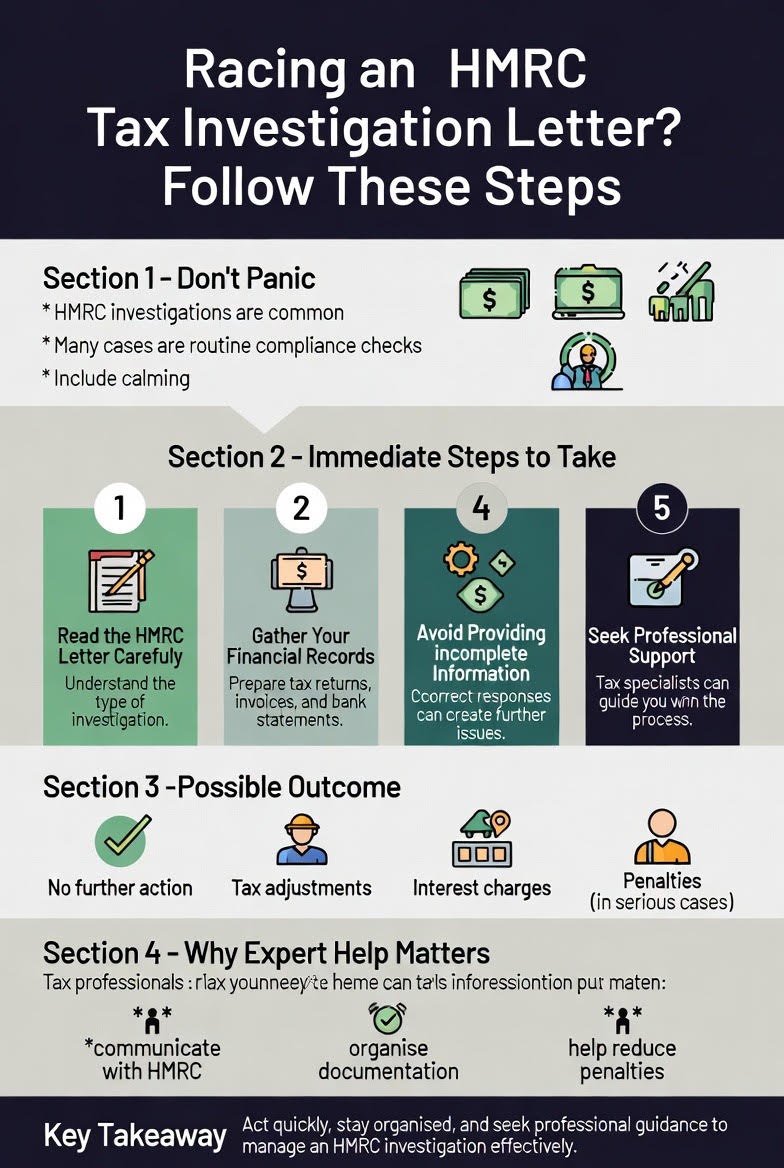
5. Step-by-Step HMRC Investigation Process
Knowing the timeline helps remove the “fear of the unknown.”
- The Notification: You receive an official letter (usually under Section 9A of the Taxes Management Act) stating the years and taxes under review.
- The Information Request: HMRC will provide a list of documents they want to see (invoices, bank statements, payroll). You usually have 30 days to comply.
- The “Questions” Phase: After reviewing your documents, the inspector will ask for clarifications. They may request a “meeting” or interview. Note: You are not legally required to attend a meeting in person if your accountant can handle it in writing.
- The Findings: HMRC will issue a letter of intent, outlining what they believe is the underpaid tax, plus interest and penalties.
- Negotiation: This is where tax investigation accountants earn their keep. We argue the interpretation of tax law to reduce the liability.
- The Settlement: Once a figure is agreed, you sign a “letter of offer” and pay the amount (or set up a payment plan).
6. What To Do Immediately After Receiving an HMRC Letter
The moments after opening that letter are critical. Your actions here can either mitigate the damage or make it significantly worse.
The “Golden Rules”:
- Don’t Ignore It: HMRC has the power to issue “best judgment” assessments. If you don’t respond, they will simply tell you what they think you owe, and it will always be the highest possible figure.
- Don’t Contact the Inspector Directly: It is human nature to want to “explain things” and be helpful. However, anything you say can be used as evidence. A casual comment about your lifestyle can be interpreted as proof of undisclosed income.
- Gather Your Records: Pull together your bank statements and receipts, but do not send them yet.
- Hire a Specialist Tax Investigation Accountant: General accountants are great for filing returns, but they often lack the “adversarial” experience needed for an investigation. You need someone who knows exactly how far HMRC’s powers go and where they stop.
7. Consequences and Penalties
HMRC doesn’t just want the missing tax; they want interest and a “fine” for the error. Penalties are based on the behavior that led to the mistake:
| Behavior Type | Penalty Range (Unprompted) | Penalty Range (Prompted/Investigated) |
| Reasonable Care | 0% | 0% |
| Careless | 0% – 15% | 15% – 30% |
| Deliberate | 20% – 35% | 35% – 70% |
| Deliberate & Concealed | 30% – 100% | 100% – 200% (for offshore) |
Beyond the Money
If the investigation reveals a “deliberate” attempt to evade tax, HMRC can publish your name on their “deliberate defaulters” list. In extreme cases involving fraud, criminal prosecution and prison time are possibilities, though HMRC prefers civil settlements where they get the money.
8. How Tax Investigation Accountants Help
Why involve a specialist? Think of it like a legal trial; you wouldn’t represent yourself in court against a veteran prosecutor.
- Acting as a Buffer: We become the “Authorized Agent.” All HMRC correspondence goes to us. You don’t have to talk to them, and they can’t bully you into making snap statements.
- Managing the Scope: HMRC inspectors often ask for more than they are legally entitled to. We ensure the enquiry stays within its “Aspect” or “Full” boundaries.
- Technical Arguments: We use tax legislation and “case law” to prove that your expenses were legitimate or that an error was “careless” rather than “deliberate,” potentially saving you 50% or more in penalties.
- Negotiating Settlements: We know what HMRC is willing to accept. We can often negotiate “Time to Pay” arrangements if the final bill is large.
9. Reducing the Risk of Future HMRC Investigations
Prevention is the best cure. Once an investigation is closed, you are on HMRC’s radar for the next few years.
- Keep Digital Records: Use software like Xero or QuickBooks. Not only does this comply with Making Tax Digital (MTD), but it also makes it much harder for HMRC to claim your records are “incomplete.”
- The “Reasonableness” Test: Before submitting a return, ask: “Does this look right for my industry?” If you are a consultant claiming £10,000 in “sundries,” expect a letter.
- Disclose Everything: If you have a one-off gain, use the “white space” on your tax return to explain it. HMRC is less likely to investigate if the explanation is already there.
- Regular Consultation: Have your tax investigation accountants perform a “mock audit” of your books once a year to spot red flags before HMRC does.
How LANOP BUSINESS & Tax Advisors Can Help
Dealing with an HMRC enquiry can be overwhelming, but LANOP BUSINESS & Tax Advisors provides expert support to guide you through the process. As experienced tax investigation accountants, the team helps you understand the scope of the investigation, prepares accurate documentation, and ensures all responses to HMRC are handled professionally.
LANOP also manages communication with HMRC on your behalf, reducing the risk of mistakes and helping present your case clearly. If discrepancies arise, their specialists work to negotiate fairly with HMRC and aim to minimise potential penalties. With the right guidance and representation, LANOP helps make the investigation process less stressful while protecting your financial interests.
Frequently Asked Questions
- Why has HMRC chosen to investigate me?
It could be random HMRC runs routine checks on a percentage of tax returns every year. Or it might be triggered by something specific: unusually high expenses, significant income changes, discrepancies between your return and third-party data, or working in a sector they’re currently targeting. Being investigated doesn’t automatically mean you’ve done something wrong. - What are the different types of HMRC investigations?
There are three main types. A full investigation examines your entire tax affairs over multiple years. An aspect inquiry focuses on a specific part of your return like business expenses or rental income. A random check is routine and not based on suspicion. The letter you receive will indicate which type you’re facing. - What should I do immediately after receiving an HMRC investigation letter?
Don’t panic, but don’t ignore it. Contact a tax specialist or accountant immediately ideally before responding to HMRC. Don’t try to handle it yourself, even if you think everything’s fine. Gather all relevant records: invoices, receipts, bank statements, contracts. And whatever you do, don’t destroy or alter any documents. - Can I handle an HMRC investigation on my own?
Technically yes, but it’s risky. HMRC officers are trained to ask questions that can inadvertently lead you to say something that complicates your case. A tax specialist knows what information to provide, how to present it, and what your rights are. They’ll handle all communication so you don’t make costly mistakes. - What records and documents will HMRC want to see?
They’ll typically request bank statements, invoices, receipts, contracts, business records, VAT returns, payroll documents, and correspondence related to the area under investigation. For self-employed individuals, they’ll want proof of income and expenses. Keep everything organized and only provide what’s requested no more, no less.
11. Conclusion: You Don’t Have to Fight Alone
An HMRC tax investigation is a stressful, time-consuming, and emotionally draining experience. It can feel like the weight of the state is leaning on your shoulders. However, most investigations end in a manageable settlement if handled correctly from day one.
The difference between a 70% penalty and a 0% penalty often comes down to the quality of your representation. Proactive, expert guidance is the only way to ensure that HMRC stays within their bounds and that you pay only what is legally required and not a penny more.
Don’t wait for the inspector to call again.
If you have received an enquiry letter or are worried about your past tax returns, contact LANOP Business & Tax Advisors. Our specialist tax investigation accountants have a proven track record of resolving complex enquiries, reducing penalties, and giving our clients their peace of mind back.
Would you like us to review your HMRC letter and provide an immediate assessment of your risk? Contact Lanop today for a confidential consultation.
Business
UAE Visa Fines Waived: Latest 2026 Update, Eligibility, Overstay Rules and Fine Reduction Options
Last Updated: August 8, 2026
The announcement that UAE visa fines waived for certain visitors and residents created considerable interest among people dealing with expired visas, cancelled residence permits and delayed departures. The relief was genuine, but it was never a permanent cancellation of every immigration fine in the United Arab Emirates. It was introduced for people who became stranded because of exceptional regional circumstances and flight disruptions beginning on February 28, 2026. The situation later changed again when authorities introduced a final 30-day period for affected individuals to leave the country or legalise their immigration status. That grace period ended on July 9, 2026, making it particularly important for travellers to understand what rules apply now.
For ordinary visa overstays, UAE immigration penalties remain in force. Official federal guidance continues to show an overstay charge of AED 50 for each applicable day after the permitted stay and any relevant grace period have ended.
This guide explains what happened with the 2026 waiver, who received relief, what changed after July 9, how current overstay penalties work and what options may still be available to people facing significant immigration fines.
UAE Visa Fines Waived in 2026: What Actually Happened?
The 2026 fine relief began because circumstances outside travellers’ control made normal departures impossible.
On March 4, the Federal Authority for Identity, Citizenship, Customs and Port Security, commonly known as ICP, announced that people who could not leave the UAE because of regional airspace closures and temporary flight suspensions would not be required to pay overstay penalties resulting from those delays.
The exemption applied to fines arising from February 28, 2026 onward for qualifying travellers.
It included people holding visit visas, tourist visas and departure permits. Residents who had already cancelled their residence permits because they intended to leave the UAE were also included when the disruption prevented their scheduled departure.
The purpose was straightforward. A traveller who had made arrangements to leave should not accumulate large immigration penalties simply because a flight was cancelled or airspace became temporarily unavailable.
However, the exemption was linked specifically to those extraordinary circumstances. It did not remove the UAE’s general visa-overstay system.
Latest UAE Visa Fines Waived Update as of August 2026
The most important development came after regional conditions stabilised.
ICP later announced that the circumstances supporting the exceptional fine exemption had ended. A 30-day grace period running from June 10 through July 9, 2026 was therefore provided to people who had previously benefited from the special relief.
During that window, eligible individuals could either regularise their immigration status if they wanted to remain legally in the UAE or leave the country under the applicable procedures.
Authorities said beneficiaries did not need to take an additional step simply to obtain the previously announced exemption. The 30-day period was designed as a final opportunity to resolve immigration status following the end of the emergency conditions.
Because today is August 8, 2026, that special grace period is no longer open.
Anyone who remained in the UAE after the end of the applicable relief period should therefore check their current immigration record rather than relying on older reports saying UAE overstay fines had been waived.
UAE Visa Fines Waived Period Has Ended for the Regional Disruption Scheme
This point deserves particular emphasis.
Articles and social-media posts from March or June may still appear in search results and can make the waiver sound active today. Those reports describe a temporary measure.
The special relief connected with the 2026 regional flight disruption ultimately moved into the June 10-July 9 grace period. The ordinary immigration framework applies again unless an individual qualifies for another specific exemption, authorised grace period or case-by-case fine reduction.
That does not mean people facing large fines have no options. It means they should not assume their penalties will disappear automatically because of the earlier announcement.
Who Qualified for the 2026 UAE Overstay Fine Exemption?
The relief was broader than a single type of tourist.
Official ICP information identified several affected groups.
Visitors who entered using a visit visa could qualify when disrupted flights prevented departure.
People travelling under a tourist visa were also covered under the same principle.
Individuals holding departure or exit permits could receive relief if they could not leave as expected.
The measure also covered certain UAE residents who had already cancelled their residency before travelling but then found themselves unable to exit because scheduled flights were suspended or affected.
The key factor was not simply that a visa had expired. The delay needed to be connected with the exceptional circumstances addressed by the authorities.
For example, someone who had been overstaying for months before February 28 should not assume that earlier violations automatically became part of the emergency waiver.
Does “UAE Visa Fines Waived” Mean Every Visa Fine Was Cancelled?
No.
This is probably the biggest misunderstanding surrounding the topic.
The UAE did not permanently abolish penalties for overstaying visas. It provided targeted humanitarian relief during an unusual disruption to regional travel.
Normal visa expiry rules continue to operate.
ICP’s current fine-payment information lists a charge of AED 50 per day for expiry of the permitted stay or relevant violations involving an entry visa, residence permit or exit permit.
Recent ICP visa information published in June 2026 also confirms a daily AED 50 penalty for overstaying the authorised period under applicable entry-visa categories.
Therefore, people should separate two different ideas:
A special government fine waiver is temporary relief introduced for defined circumstances.
A normal visa overstay occurs when a person remains beyond their legally permitted period without another exemption or authorised status.
Confusing the two can result in penalties continuing to accumulate.
How Much Is the UAE Visa Overstay Fine in 2026?
The federal overstay penalty is generally AED 50 for each chargeable day.
The UAE government’s official portal says that visit, tourist and residence visa overstaying fees have been standardised at AED 50 per day.
ICP’s online fine-payment service likewise lists AED 50 per day for expiry of the authorised stay connected with entry visas, residence permits and certain other immigration documents.
To understand the financial impact, consider a simple example.
If a person has 10 chargeable overstay days, the basic daily fine would amount to AED 500.
Thirty chargeable days would equal AED 1,500.
Sixty chargeable days would equal AED 3,000.
These examples relate only to the daily fine calculation. Other service, application, exit or administrative costs may depend on the particular immigration procedure required.
The exact amount owed should therefore be confirmed through the relevant authority rather than estimated from the visa expiry date alone.
When Do UAE Overstay Fines Start?
A common mistake is assuming that every residence holder begins paying fines the day after the printed residence expiry date.
That is not always the case.
Different residence categories can have different legal grace periods.
Current ICP service information provides grace periods ranging from 30 days to 180 days, depending on the type of residence permit.
For example, ICP states that Golden, Green and Blue Residence holders and certain other qualifying categories can receive a 180-day grace period after expiry or cancellation.
Some skilled professionals and property owners receive a 90-day period.
Certain residence permits issued through a guarantor or host receive 60 days.
Other categories may receive a 30-day period.
This is why two people whose residence visas expire on the same day may not necessarily begin accumulating overstay penalties on the same date.
Why Your UAE Visa Grace Period Matters
The grace period is effectively the gap between the end of the residence permit and the date by which the person must complete the next legal step.
During that time, someone might leave the country, obtain another eligible residence status or complete an approved immigration procedure.
Once the relevant grace period ends, staying in the UAE without valid status can trigger the daily overstay charge.
For this reason, people should check their own immigration category rather than following advice from a friend, employer or online forum whose visa circumstances may be completely different.
Can UAE Visa Fines Still Be Waived After July 9, 2026?
The earlier regional-disruption waiver should not be treated as an ongoing blanket exemption.
However, a separate mechanism exists in Dubai for people seeking a reduction or exemption from certain residence-law fines.
GDRFA Dubai maintains an official service allowing an applicant to request that a financial penalty for violating foreigner entry and residence rules be waived or reduced.
The service requires a copy of the violator’s passport and a letter explaining the circumstances that resulted in the violation and the person’s inability to settle the amount. The Fines Committee may request additional evidence.
Approval is not guaranteed.
The existence of the service means authorities can review individual circumstances, but every case is considered separately.
How to Request UAE Visa Fines Waived or Reduced in Dubai
People dealing with a Dubai immigration file should begin by checking whether their case falls under GDRFA Dubai.
A fine-reduction request normally needs a clear explanation rather than a short statement asking authorities to cancel the amount.
The applicant should explain when the immigration problem began, what caused it, why it could not be resolved earlier and why payment of the full penalty creates difficulty.
GDRFA lists the passport copy and explanatory letter among its requirements and confirms that the Fines Committee can ask for further supporting documents.
Evidence can be especially useful when unusual circumstances contributed to the overstay.
Depending on the case, documents might include visa cancellation records, employment documentation, evidence of travel disruption or other records directly connected with the immigration violation.
Applicants should make sure every statement is truthful. False documentation or invented explanations can create far more serious problems than an ordinary overstay fine.
ICP or GDRFA: Where Should You Check Your Visa Fine?
The correct authority generally depends on the immigration file.
For federal immigration matters covering the relevant emirates outside Dubai, the Federal Authority for Identity, Citizenship, Customs and Port Security provides visa, residence and fine-payment services.
Dubai immigration files are generally handled through the General Directorate of Identity and Foreigners Affairs Dubai, or GDRFA.
Knowing which authority controls the file can save considerable time.
If the visa was issued through Dubai, GDRFA should normally be the first point of reference for the appropriate Dubai immigration procedure.
For qualifying federal visa and residency matters, ICP’s smart services provide access to immigration procedures, fine-payment services and related information.
What If Your UAE Residence Visa Was Cancelled?
Cancellation does not mean a former resident can necessarily remain indefinitely.
After a residence visa is cancelled, the person must consider the applicable grace period for that residence category.
ICP currently states that different grace periods may apply after cancellation, including 30, 60, 90 or 180 days for defined categories. Once the applicable period ends, an AED 50 daily fine can be imposed for remaining in the UAE.
People whose employment has ended should therefore avoid focusing only on the date their labour relationship ended.
The immigration cancellation date and applicable residence grace period are also important.
An employer cancelling a residence permit does not automatically mean the employee starts overstaying the following morning.
What Happens If You Need an Exit Permit?
People with unresolved immigration status sometimes need a departure permit before leaving the UAE.
ICP’s current departure-permit information says the regular exit-permit process requires outstanding fines to be settled. It also states that departure should take place within seven days after the permit is issued.
The exact procedure can differ according to the person’s immigration record and circumstances.
Anyone with a large overstay amount should therefore check the required process before booking a non-refundable flight or assuming that simply arriving at the airport will resolve the problem.
How to Avoid New UAE Visa Overstay Fines
The easiest visa fine to deal with is the one that never starts accumulating.
Visitors should know how long their authorised stay actually lasts. The duration of stay may not always be the same as the period during which an entry visa can initially be used.
Residents should track residence expiry dates and understand the grace period attached to their category.
People changing employers should confirm that the new residence process has actually been completed rather than assuming that an employer or agent has finalised it.
Tourists extending their stay should make sure the extension has been approved before the existing legal stay ends.
Travellers affected by cancelled flights should retain airline emails, booking records and cancellation notices. If another exceptional government relief measure is announced in the future, such documents can help establish what happened.
Most importantly, travellers should use official immigration channels instead of relying on viral messages promising a “UAE fine cancellation” for everyone.
Why Old UAE Visa Fine Waiver News Can Be Misleading
Immigration content has a particularly long life online.
A headline published months earlier can continue appearing in Google results even after a deadline has passed.
That is exactly why the phrase UAE visa fines waived requires a date alongside it.
The original ICP relief began in response to disruptions from February 28, 2026.
The authority later gave affected people a final 30-day period from June 10 to July 9 to adjust their legal status or depart.
By August 2026, that temporary period had finished.
An article that reports only the March waiver without mentioning the July deadline can therefore give readers an incomplete impression of the present situation.
For immigration decisions involving money, employment or travel, always check the publication date of any information you read.
UAE Visa Fines Waived and Current Status: What You Should Do Now
If you currently have an expired UAE visa or residence permit, start by checking your actual immigration status.
Determine the type of visa you hold or previously held.
Confirm the expiry or cancellation date.
Check whether a statutory grace period applies.
Establish whether an overstay fine has begun accumulating.
If you were previously part of the exceptional 2026 waiver group but did not regularise your status or depart by July 9, seek current information from the competent immigration authority rather than relying on the former relief period.
People with Dubai files who have genuine circumstances making payment difficult may also investigate GDRFA’s official fine exemption or reduction procedure.
The central point is simple: do not assume that an old fine-waiver announcement means your current immigration record is clear.
Conclusion: What the UAE Visa Fines Waived Update Means Today
The UAE visa fines waived story of 2026 began as a humanitarian response to extraordinary regional travel disruption. ICP protected qualifying tourists, visitors, exit-permit holders and former residents from penalties caused when airspace restrictions and flight suspensions prevented them from departing from February 28 onward.
When conditions stabilised, authorities moved the scheme toward closure. A final 30-day grace period ran from June 10 to July 9, 2026, allowing previously affected individuals to leave the country or regularise their immigration status. That deadline has now passed.
As of August 8, 2026, ordinary UAE immigration rules should therefore be the starting point for anyone checking an overstay problem. Federal guidance continues to show a standard daily overstay penalty of AED 50 after the authorised period and applicable grace period have ended.
There can still be important differences between individual cases. Residence categories have varying grace periods, and Dubai offers a formal process through which eligible applicants can ask GDRFA to consider reducing or waiving certain immigration fines.
The safest approach is to verify your exact status through ICP or GDRFA, act before additional penalties accumulate and treat social-media claims of universal visa-fine cancellation with caution.
FAQs About UAE Visa Fines Waived
1. Are UAE visa fines waived for everyone in August 2026?
No. There is no indication in the official sources reviewed for this update that all UAE visa overstay fines are currently cancelled. The major 2026 exemption related to travellers affected by exceptional regional flight disruption, and the subsequent 30-day period for affected people to regularise their status or leave ended on July 9, 2026.
2. How much is the UAE visa overstay fine in 2026?
ICP currently lists the standard overstay fine at AED 50 per applicable day for expiry of the permitted stay connected with an entry visa, residence permit or certain other immigration documents. The charge generally begins after the authorised stay and relevant grace period have ended.
3. Can I request a UAE visa fine reduction if I cannot afford the full amount?
For Dubai immigration cases, GDRFA provides an official service through which a person can request an exemption or reduction of certain financial penalties. Applicants need to provide the required documents and explain the reasons for the immigration violation and inability to pay. Approval remains subject to review by the relevant authority.
4. How long is the grace period after a UAE residence visa is cancelled?
There is no single grace period for every resident. Current ICP information shows different periods depending on residence category, including 30, 60, 90 and 180 days. Golden, Green and Blue Residence holders and certain other groups may qualify for the longest period, while other residence categories receive shorter periods.
5. Is the June-July 2026 UAE visa fine grace period still available?
No. The special 30-day period started on June 10, 2026 and ended on July 9, 2026. It applied to people who had previously benefited from the exceptional overstay-fine relief linked to regional travel disruption. Anyone dealing with an immigration issue after that date should check their current status directly with ICP or GDRFA.

Tozymagazine.com is a general-interest content website that publishes articles across a surprisingly wide range of subjects. Although the platform originally presented itself as a place for quotes, wishes, thank-you messages, and words for special occasions, its present-day content extends far beyond sentimental writing. Readers can now find material related to business, technology, health, finance, lifestyle, home improvement, travel, gaming, and product news.
That variety can make the website useful for casual browsing, topic discovery, and introductory research. However, a broad publication also requires readers to evaluate each article separately. An entertaining lifestyle post does not need the same level of verification as medical, financial, or legal guidance.
This guide explains what the website offers, how it has changed, what kind of reader may benefit from it, and how to use its information responsibly.
What Is Tozymagazine.com?
Tozymagazine.com is an online publishing platform built around accessible, search-friendly articles. Its official About page describes the site as a collection of quotes, wishes, messages, and emotional expressions for birthdays, marriages, anniversaries, and thank-you occasions. The website says its original purpose was to help people find meaningful words for cards, notes, celebrations, and personal communication.
That description still appears in the site’s branding and main navigation. Visitors can see categories such as Marriage, Birthday, Anniversary, Thank You, Trending, and Blog. However, the articles currently displayed on the homepage demonstrate that the platform has developed into a broader digital magazine.
Recent posts cover topics such as aviation supply chains, food distribution, artificial intelligence in game design, periodontal treatment, real estate funds, Facebook marketing, investment planning, and accessory dwelling units. This suggests that Tozy Magazine now operates more like a multi-topic blog than a website focused only on wishes and quotations.
How Tozymagazine.com Has Evolved
The development of the site is one of its most notable characteristics.
Its older identity is clear. The About page focuses heavily on emotional writing, relationships, gratitude, celebrations, and meaningful messages. It describes the publication as a place where readers can find the right words for life’s special moments.
Older content also supports that identity. For example, the website has published collections of evening blessings, prayers, wishes for friends, inspirational quotations, and shareable messages. These articles are structured to help visitors quickly find text they can use in a greeting, social media post, card, or personal message.
The current homepage presents a different editorial direction. Its newest articles include business guides, health discussions, product-related posts, investment content, technology explainers, and news-style features. The website archive extends across dozens of pages, indicating a substantial and continuously expanding collection.
This change does not necessarily make the website better or worse. It simply means readers should understand that the platform’s original description no longer represents the full range of material being published.
Main Content Categories on Tozymagazine.com
Wishes, Quotes, and Special Occasions
Sentimental content remains an important part of the website’s archive. Readers may find birthday messages, anniversary wishes, marriage quotations, thank-you notes, blessings, prayers, apologies, and captions.
These articles are usually organized into practical groups. A collection of evening blessings, for example, separates general blessings from prayers, friendship messages, evening wishes, and inspirational quotations. This format makes it easy to locate wording for a particular person or situation.
This section of the website may be useful when you need inspiration but do not know how to begin a message. It is still wise to personalize any quotation or wish before sending it. Adding a name, shared memory, or specific detail can make a general message feel more sincere.
Business and Finance
Business has become one of the more visible subjects on the website. Recent articles discuss food distributors, social media growth, real estate investment funds, changing market conditions, recruiting metrics, financial technology, and business consulting.
Some of these posts work as introductory explainers. They can help readers become familiar with common terminology or identify questions to research further. For example, a general article about investment planning may introduce diversification, market conditions, long-term thinking, and risk awareness.
Readers should not treat broad financial articles as personalized investment advice. Financial decisions depend on income, debt, taxation, time horizon, risk tolerance, and local regulations. Any major decision should be verified through official documentation or discussed with an appropriately qualified professional.
Technology and Artificial Intelligence
The publication also covers software, online platforms, artificial intelligence, digital tools, gaming technology, and content-production workflows.
One 2026 article, for example, compares tools that can convert PDF files into editable presentation formats. It discusses products such as Adobe Acrobat, Microsoft PowerPoint, Canva, LibreOffice Impress, and Pandoc. The article is organized around different user needs, including business workflows, open-source use, and automated document processing.
Other technology-related posts discuss game visuals, crypto trading systems, online gaming infrastructure, and financial technology. This range gives casual readers access to many topics, although the technical depth can differ considerably from one article to another.
Health and Wellness
Health content appears regularly among recent posts. Topics include periodontal treatment, weight management, skincare, medical relief, personal care, and recovery after injuries.
This is an area where careful verification is especially important. Some articles may provide reasonable general education, but medical recommendations should be supported by credible clinical evidence and reviewed in the context of an individual’s health.
For example, the website has published an article discussing the combination of L-carnitine and semaglutide for weight management. Because semaglutide is a medication and supplement interactions can depend on a person’s health, dosage, and treatment plan, readers should not begin or modify treatment based only on a general online article.
Use health posts as starting points for questions, not as substitutes for medical diagnosis or professional care.
Lifestyle, Travel, and Home Improvement
Tozy Magazine’s broader lifestyle coverage includes travel planning, jewelry, major life transitions, home projects, fashion, relationships, and consumer choices.
Its travel-related material may introduce packing strategies, budgeting ideas, itinerary planning, and cultural preparation. One travel guide, for example, discusses early planning, flexible schedules, packing light, destination research, and local experiences.
Home improvement content has recently included accessory dwelling units, backyard cottages, home offices, studios, permits, design services, and California construction projects. Some posts appear to focus on particular businesses or service providers, so readers should distinguish between independent education and promotional material.
Product News and Commercial Content
The site publishes product comparisons, brand-focused articles, and content discussing specific services or commercial providers. Examples include robotic pool cleaners, auditorium seating systems, LED walls, design tools, and construction companies.
Commercial articles can be helpful for discovering products or learning which features are available. However, publication on a magazine-style website should not automatically be interpreted as independent testing or endorsement.
Before purchasing a product, verify specifications on the manufacturer’s official website, compare prices across reputable sellers, check warranty terms, and read customer feedback from more than one source.
Tozymagazine.com at a Glance
| Area | What Readers Can Expect |
|---|---|
| Website type | General-interest online magazine and blog |
| Original focus | Quotes, wishes, gratitude, and special occasions |
| Current focus | Business, technology, health, lifestyle, finance, news, and product content |
| Access | Public articles that can be opened without creating an account during this review |
| Article format | Headings, short paragraphs, tables of contents, lists, and explanatory sections |
| Contact method | Website contact form and an email listed on the About page |
| Best use | Casual reading, introductory learning, wording inspiration, and topic discovery |
| Main limitation | Depth, sourcing, and author expertise may vary between articles |
The public Contact page includes fields for a name, email address, subject, and message. The About page also provides an email contact.
What Makes Tozymagazine.com Useful?
A Wide Selection of Topics
The biggest advantage is variety. A visitor may arrive for a birthday wish and later discover articles about technology, business, travel, home improvement, or personal finance.
This broad coverage makes the platform suitable for readers who enjoy exploring different subjects without visiting several specialized publications.
Simple and Scannable Formatting
Many articles use straightforward headings, tables of contents, short sections, and descriptive subheadings. This helps readers scan a page and move directly to the information that interests them.
The wishes and quotations content is particularly easy to browse because messages are grouped by purpose, relationship, or emotional tone.
Content for Beginners
Many posts appear to be written for readers who are unfamiliar with a subject. Instead of assuming expert knowledge, the articles often begin with basic definitions and gradually introduce the topic.
This can make Tozymagazine.com useful for building initial awareness before moving to more technical or authoritative resources.
Regular Publication Activity
The homepage showed new articles dated through August 5, 2026 during this review. Recent posts covered aviation, food distribution, gaming visuals, health, construction, marketing, and investment planning.
Regular publication can keep a website active, but frequency alone does not prove accuracy. Every article still needs to be assessed on its own evidence and quality.
Limitations Readers Should Understand
The About Page Does Not Fully Match the Current Website
The official About page still emphasizes wishes, quotations, birthdays, marriages, anniversaries, and gratitude. Meanwhile, the homepage now contains a much broader mix of commercial, technical, medical, financial, and general-interest articles.
This inconsistency may leave new readers uncertain about the publication’s primary editorial purpose.
Author Expertise Is Not Always Clear
Many recent posts are attributed to an author named Devwiz. The author archive displays published articles and an avatar, but the inspected page does not provide a detailed professional biography, credentials, or subject-specific qualifications.
That absence matters most when an article covers health, law, investment, or another high-stakes subject. Clear author information helps readers understand whether the writer has relevant experience.
Source Quality Can Vary
Some articles provide useful explanations but do not always make supporting evidence immediately visible. A reader may need to independently confirm statistics, medical claims, product features, financial information, or legal guidance.
A trustworthy reading habit is to ask:
Who wrote the article?
When was it published or updated?
Does it link to original evidence?
Is a company, product, or service being promoted?
Can the main claims be confirmed through official or specialist sources?
Commercial Intent May Not Always Be Obvious
Certain posts focus heavily on named companies, products, platforms, or service providers. That does not automatically make the information false, but it can affect how the content is framed.
When an article strongly recommends a specific brand, search for independent comparisons before making a decision.
Is Tozymagazine.com Safe to Use?
For ordinary browsing, the website’s public pages were accessible during this review, and the site provides a contact form and public-facing content archive. However, technical accessibility is different from editorial reliability.
No website should receive unlimited trust simply because it loads properly or uses a professional layout. Safety also depends on how you interact with the content.
Avoid entering sensitive financial, medical, identity, or payment information into unfamiliar forms. Do not download unexpected files. Verify external links before opening them. Use strong browser security settings and keep your device updated.
Most importantly, separate low-risk and high-risk content. A birthday message or travel inspiration article usually carries little risk. A medical treatment claim, investment recommendation, legal instruction, or product purchase requires stronger verification.
How to Evaluate an Article on Tozymagazine.com
Begin by checking the publication date. Older articles may contain outdated product information, pricing, laws, medical guidance, or platform features.
Next, identify the author. Look for a biography, credentials, professional experience, or links to other work. If no expertise is provided, treat the article as general information.
Study the language. Overly confident promises, guaranteed results, urgent calls to action, and claims that sound too good to be true should encourage further checking.
Look for evidence. Strong articles usually identify where statistics, quotations, scientific claims, or technical specifications came from.
Finally, compare the central claims with at least two stronger sources. Official government websites, recognized medical institutions, peer-reviewed research, product documentation, and established professional organizations are generally better suited to important decisions.
Who Should Read Tozymagazine.com?
The website may suit readers looking for:
Personal messages and wishes for special occasions
Simple introductions to unfamiliar subjects
Ideas for lifestyle, travel, and home-related research
General explanations of business or technology concepts
Product and service discovery
Casual reading across several categories
It is less suitable as a single authoritative source for medical treatment, legal action, investing, safety procedures, or expensive purchasing decisions.
Final Conclusion
Tozymagazine.com has developed from a website centered on wishes and emotional expressions into a broad online publication covering business, technology, health, lifestyle, finance, product news, travel, and home improvement.
Its strengths include accessible writing, broad topic coverage, scannable formatting, and a large archive. Readers can use it to discover ideas, understand basic concepts, or find inspiration for personal messages.
Its limitations are equally important. The official About page does not fully reflect the website’s current direction, detailed author credentials are not always visible, and the level of sourcing may differ between articles. Commercial and high-stakes content therefore requires independent verification.
The best approach is neither to dismiss the website nor trust every article automatically. Use it as an entry point. Read critically, identify the purpose of each post, confirm important claims, and rely on qualified sources before making decisions involving your money, health, legal rights, or personal safety.
Frequently Asked Questions
1. What is Tozymagazine.com mainly used for?
Tozymagazine.com is a general-interest content website. It originally focused on wishes, quotations, birthdays, marriages, anniversaries, and thank-you messages, but it now publishes material about business, technology, health, finance, lifestyle, travel, home improvement, and products.
2. Is Tozymagazine.com free to read?
The public pages examined during this review could be opened without creating an account or purchasing a subscription. Readers should still check individual pages because the website’s access model could change.
3. Can I trust health and financial articles on Tozymagazine.com?
Such articles may provide introductory information, but they should not be your only source. Verify health claims with qualified medical professionals and reliable clinical sources. Confirm financial information through regulated professionals, official documents, and established financial institutions.
4. Does Tozymagazine.com still publish wishes and quotes?
Yes. The website maintains categories related to birthdays, marriage, anniversaries, gratitude, blessings, and personal messages. Its archive includes large collections of quotations and wishes for different relationships and occasions.
5. How should I use information from Tozymagazine.com?
Use the website for general education, inspiration, topic discovery, and preliminary research. Check the article date, author, evidence, and possible commercial intent. Confirm important information through authoritative sources before acting on it.


Facing an HMRC Tax Investigation? Here’s What to Do

Eurogamersonline.com console gaming: A Complete 2026 Guide for Modern Gamers

Eurogamersonline.com: A Complete Guide to Its Gaming Content in 2026

Snigdhasnack: The Complete Guide to Smart, Flavorful, and Balanced Snacking

I Want to Do Advanced Topical SEO Around One Main Keyword: Best Cocido Gallego Near Me

What Is Tracqueur? The Complete Guide to Smart Tracking
-
 Food4 months ago
Snigdhasnack: The Complete Guide to Smart, Flavorful, and Balanced Snacking
-
 Food4 months ago
I Want to Do Advanced Topical SEO Around One Main Keyword: Best Cocido Gallego Near Me
-
 Tech4 months ago
What Is Tracqueur? The Complete Guide to Smart Tracking
-

 Tech4 months ago
Zingyzon Com in USA: Features, Uses, Safety, and User Guide
-

 Health4 months ago
Best Locro de Zapallo Near Me: How to Find the Most Authentic Bowl and What to Expect
-

 Gaming4 months ago
Connector HSSGamepad: A Clear Guide to Setup, Modes, and Compatibility
-

 Blog4 months ago
Fascisterne: Meaning, History, Symbols, and Modern Use
-

 Blog4 months ago
Best Wireless Earbuds Under $200 in 2024: Top Picks for Sound, ANC, Battery, and Fit